Newsroom | Transforming Hospitality in the Face of Climate Risks
Expert Insights:
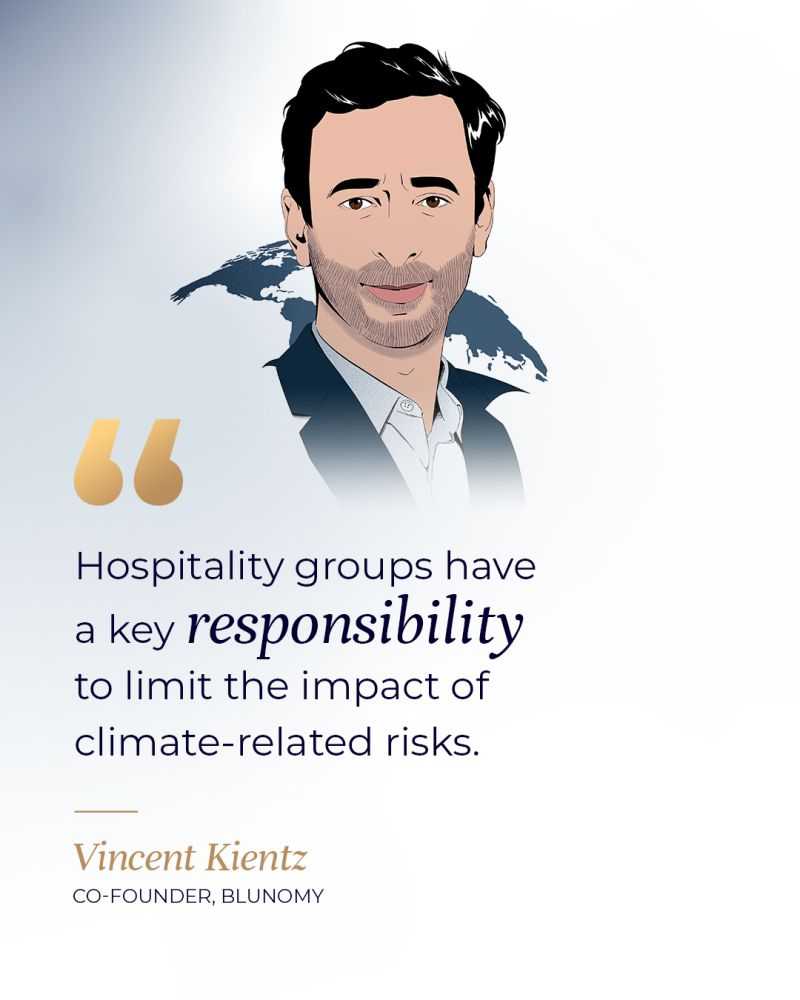
Vincent Kientz
Cofounder of Blunomy, a specialist advisory firm partnering with organizations around the world to accelerate the climate and energy transition.
“Hospitality groups have a key responsibility to limit the impact of tourism on the ecosystem.”
Vincent Kientz co-founded Blunomy in 2022 to combine expertise, tools, and capital in service of the environmental transition. From the beginning, he has supported European energy and industrial companies on strategic projects, business development, and portfolio transformation. In 2014, he developed a segment for private equity and infrastructure funds and contributed to new investment these, transactions and portfolio support as well as the development of the first tools linking ESG and value creation.

How would you describe the perception of sustainability in the hospitality industry in 2025?
Hospitality groups have a key responsibility to limit the impact of tourism on ecosystems and society. A range of actions need to become market standards, including sustainability-by-design for new hotels, as well as offerings and practices around energy, water and resource consumption and efficiency, sustainable sourcing, waste management and circularity.
Groups will differentiate by changing the way hospitality is offered – for instance by incentivizing local tourism, offering built environments that minimize impacts on local ecosystems, and working with communities to regenerate them.
Luckily, the leading groups have a clear understanding of the main impacts along the hospitality value chain, conducting data-based assessments of their current and future situations. Leaders select and model the impact reduction levers that are within reach of hospitality groups (e.g. within the procurement offer and brand standards) and of external stakeholders (such as hotel owners, operators, guests and suppliers).
What is the business case for prioritizing sustainable hospitality?
Sustainability risks are increasingly material to the financial trajectory of hospitality companies. Climate hazards have multiplied and intensified, with drought, heat and property damage already having tangible economic impacts in many regions of the world.
These hazards must be anticipated and incorporated into hospitality groups' development strategies, with some regions and hotel projects less impacted than others. Tourism flows are sensitive to these risks: 81% of Europeans traveling in Spring/Summer 2025 said the changing climate affects how they travel, and 14% avoid destinations prone to extreme heat, according to the European Travel Commission.
We also see owners increasingly expecting support in responding to sustainability-related risks (such as insurability, adaptation and mitigation solutions) and opportunities (such as efficiency gains that improve operating margins).
The challenge is, then, to identify and scale solutions that create value while reducing impact and anticipating risk. The good news is that many impact-reduction initiatives also significantly lower exposure to sustainability risks and protect long-term value.
How would you describe the cultural climate around sustainability in 2025? In what direction does it look to be going in 2026?
We see an acceleration in the shift from claims to action. Sustainability is moving from an ESG, compliance, and voluntary approach to a more strategic, financial, and operational approach, with better consideration of local specificities.
This was already the case in Asia, where a pragmatic, business-driven approach dominates. Europe, by contrast, has experienced internal conflict between the desire to maintain leadership in sustainability policies and the need for simplification to enable better implementation. In the United States, there is a growing gap between political attempts to backtrack on ESG ambitions and the economic conditions that increasingly call for sustainability-related business strategies.
“We see owners expecting support in responding to sustainability-related risks.”
2026 should be a year of implementation acceleration, focusing on what works technically and economically. For hospitality groups, this means adapting to stakeholder constraints (including owners' financing and operational capacities) and to local context (cost, benefit and impact of actions) to offer the most appropriate solutions and business models. This starts with those that generate short-term value (e.g. energy/water/resource efficiency), align interests and anchor owners in a sustainability planning mindset that protects long-term value.