Climate Risks in CSRD Reporting: Blunomy Contributes to a Landmark IFD Report


The Institut de la Finance Durable (IFD) has published its landmark report, "Risques climatiques: quels enseignements tirer des premiers états de durabilité CSRD ?" — a comprehensive study analyzing how the "first wave" of European companies is integrating climate risks into their initial sustainability statements under the Corporate Sustainability Reporting Directive (CSRD). Blunomy is proud to have actively contributed to this pivotal work.
Why This Report Matters
The rollout of the CSRD represents a profound shift toward transparency, establishing a common language and shared standards for ESG data. However, understanding climate materiality is no longer just a regulatory box-ticking exercise; it is an operational and strategic requirement for corporate resilience.
The data from this inaugural reporting cycle is clear: climate change is universally recognized, with 98% of European corporations (and nearly 100% in France) identifying it as a material issue. Yet, a significant gap remains between recognizing a risk and acting on it. While carbon mitigation and transition pathways are heavily prioritized, structured action plans for physical climate adaptation remain critically rare. This report provides the market with an essential baseline of where corporate Europe stands today and identifies the best practices needed to accelerate progress.
What the Report Finds
The first CSRD exercise reveals a highly nuanced landscape across sectors and geographies:
- The Adaptation Paradox: While 70% of European companies acknowledge climate adaptation as a material issue—surging to 83% in France and 93% in Spain—structured adaptation plans are still lagging. For instance, only 25% of French SBF 120 companies have formalized a resilience plan to counter physical climate risks.
- A Lack of Financial Quantification: Fewer than 15% of companies have communicated quantified financial impacts of their climate risks. This is largely due to the "phase-in" flexibility allowed by regulators, alongside a broader market immaturity in standardizing financial impact methodologies.
- Value Chain Vulnerabilities: Risks are heavily concentrated in companies' own operations for energy and industrial sectors. Conversely, the consumer goods sector faces severe, unmapped exposures upstream in its supply chain due to raw material sensitivity to climate hazards.
- Time Horizon Mismatches: Companies generally anticipate transition risks over the medium term (45%) but relegate physical climate risks to the long term (41%), potentially delaying urgent adaptation investments.
Blunomy's Contribution
Blunomy contributed to this structural market assessment in two complementary ways:
- Working Group Expertise: As an active participant in the IFD Working Group on "Analyse extra-financière - Risques climat," we brought our deep expertise in energy transition, climate strategy, and corporate reporting frameworks to help shape the report's core insights and methodological observations.
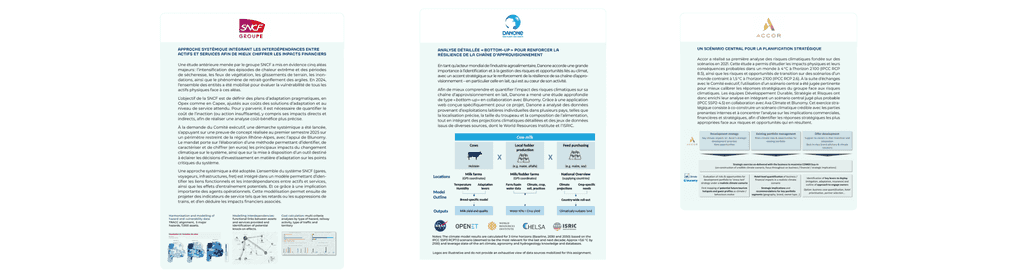
- Deploying Best Practices in the Field: We partnered directly with several corporate pioneers featured in the report to move past compliance and embed climate resilience into corporate strategy. The report highlights three specific case studies fueled by Blunomy's methodologies:
◦ SNCF Group: Blunomy supported a systemic proof of concept to model and financially chiffer (in euros) the functional interdependencies and knock-on effects of climate hazards across stations, passengers, and rail infrastructure.
◦ Danone: We co-developed a granular, bottom-up digital application analyzing individual farm-level data (GPS coordinates, herd size, water metrics) to quantify and mitigate water and thermal stress risks across their critical milk supply chain.
◦ Accor: Alongside Axa Climate, Blunomy collaborated with Accor’s Sustainability, Strategy, and Risk teams to co-construct a realistic central climate scenario (SSP2-4.5), translating climate data into concrete commercial, financial, and strategic responses to maximize executive buy-in.
This dual involvement reinforces our core conviction: climate reporting only drives true value when regulatory compliance is transformed into actionable, cross-functional corporate strategy.
→ Read the full report: IFD Rapport Risques climatiques quels enseignements tirer des premiers états de durabilité csrd
→ To learn more about Blunomy's climate risk quantification, supply chain resilience tools, and CSRD strategic alignment, get in touch with our team.

Q&A
Q: How can European companies bridge the gap between CSRD climate reporting and actionable resilience?
A: By moving past compliance to quantify financial impacts and integrate physical climate adaptation directly into cross-functional corporate strategies, as demonstrated by Blunomy and IFD.